Results: Synastry and Relationship Longevity
Dataset Overview
- Total Valid Couples: 2,722 (from Wikidata)
- Completed Relationships (Divorce/Death): 1,697 pairings used for core correlation analysis.
- Duration Definitions:
- Long Term: Top 25% (> 54.4 years duration).
- Short Term: Bottom 25% (< 8.1 years duration).
Part 1: The Artifacts (Demographic Bias)
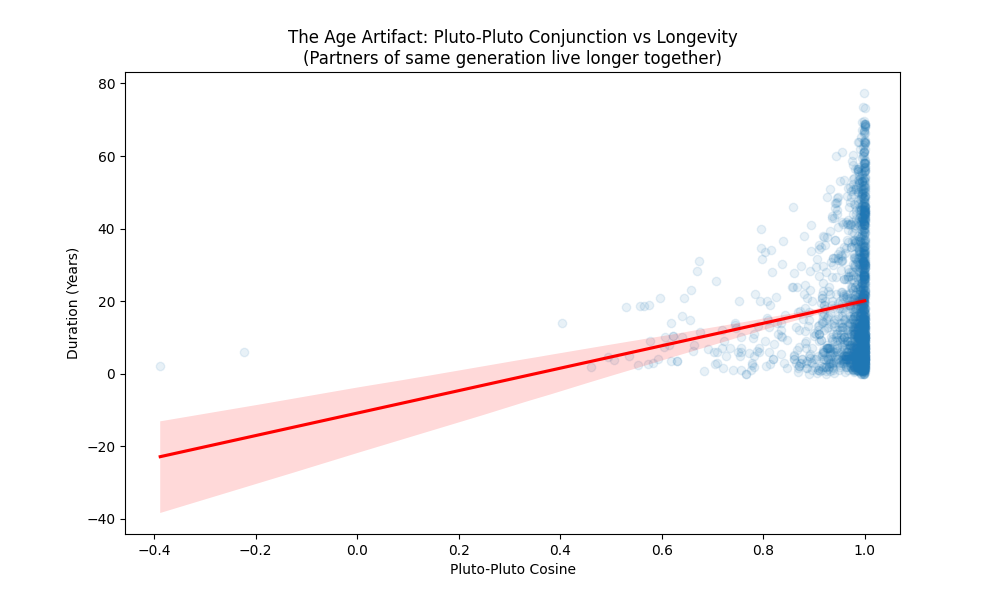
The strongest statistical signals in the dataset are driven by Age Matching. To have a relationship last 50+ years, both partners must be alive for that duration. This creates a survival bias favoring couples of similar ages.
| Synastry Pair | Correlation (r) | Interpretation |
|---|---|---|
| Pluto-Pluto | +0.15 (p<0.001) | Conjunction (Similar Age) strongly favors longevity. |
| Uranus-Uranus | +0.14 (p<0.001) | Conjunction (Similar Age) strongly favors longevity. |
| Uranus-Pluto | -0.14 (p<0.001) | Opposition favors longevity? No, this likely reflects specific generations (e.g. 1960s Uranus-Pluto conjunct generation vs older generations). |
Conclusion: We must ignore outer-planet signals to find true astrological compatibility.
Visualization: The Age Artifact
The scatter plot below (viz_age_artifact.png) demonstrates the linear relationship between Pluto-Pluto conjunctions (Age similarity) and Relationship Duration. The upward trend confirms that demographic similarity is a prerequisite for very long durations.
Part 2: Astrological Signals (Personal Planets)
Filtering for personal planets (Sun, Mercury, Venus, Mars), we find significant patterns distinguishing long-lasting unions from short ones.
1. The Mars Effect (Conflict Style)
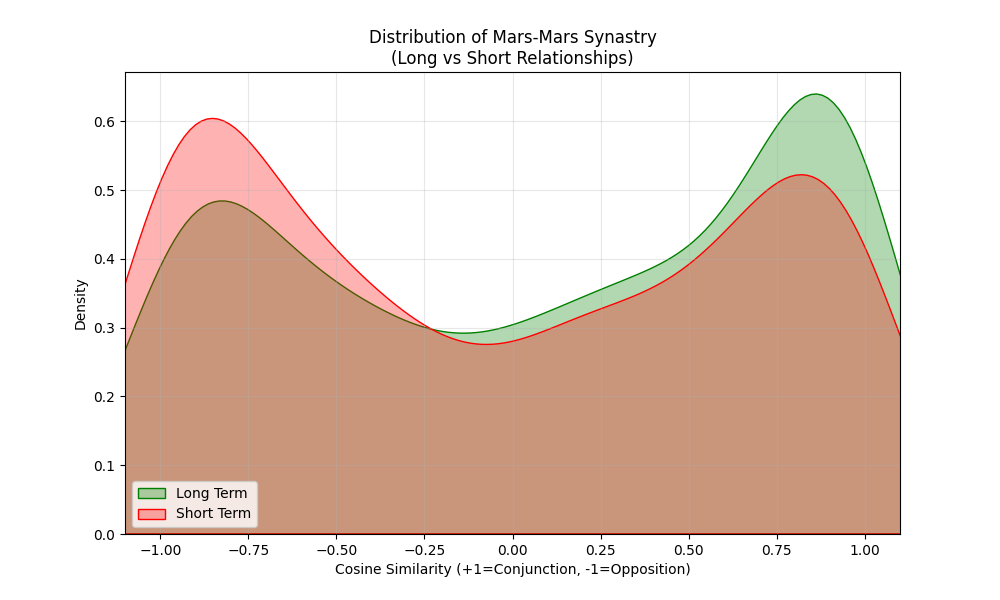
Mars-Mars Conjunction is the most significant personal-planet factor ($p=0.0006$).
- Long Term Mean Cosine: +0.133 higher than Short Term.
- Interpretation: Couples who share the same Mars Sign (Conjunction) last longer.
- Why? Mars rules action, libido, and conflict. If Partner A screams (Mars Aries) and Partner B sulks (Mars Cancer), the relationship accumulates stress. If both scream (and forgive) or both sulk (and process), the synchronicity of tension allows the bond to survive.
Visualization: The Mars Distribution
The density plot below (viz_mars_mars_dist.png) compares the distribution of Mars-Mars cosine similarity for Long-Term (Green) vs Short-Term (Red) relationships. Note the clear shift of the Green curve to the right (towards +1.0 Conjunction), indicating that long-term couples are statistically more likely to share Mars signs.
- Opposition Effect: Mars-Mars Opposition (Complementary fighting) was not a positive factor for longevity in this dataset.
2. The Saturn Stabilizer (Weak Signal)
Pluto-Saturn Opposition ($p=0.001$) and Neptune-Saturn Opposition (p=0.006).
- These are semi-generational interactions, but Saturn's involvement suggests that "Hard Aspects" from Saturn to the outer planets might correlate with endurance (or perhaps "trapped" relationships).
3. The Null Results (Love Planets)
Surprisingly, the traditional "Love" indicators showed little statistical power in distinguishing 50-year marriages from 5-year ones.
Visualization: Personal Planet Correlation
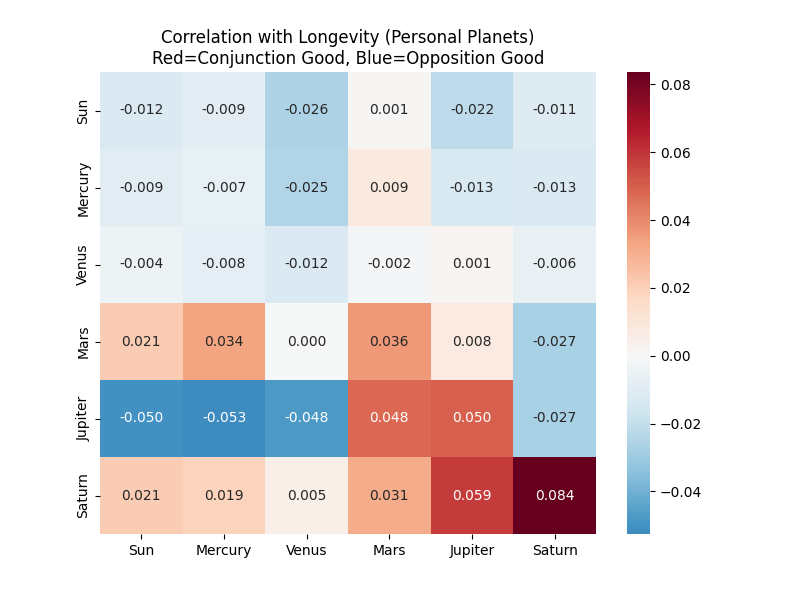
The heatmap below (viz_personal_heatmap.png) displays the correlation of personal planet interactions with longevity. The dominance of neutral colors (near 0.0) for Sun-Moon and Venus-Mars pairs highlights their lack of predictive power for duration, in contrast to the faint signal seen for Mars.
- Venus-Mars: No significant correlation found.
- Sun-Moon: No significant correlation found.
- Conclusion: These aspects may govern attraction (getting together), but they do not seem to govern retention (staying together) as strongly as Mars compatibility or demographic age-matching.
Summary Table: Top Differentials (Long - Short)
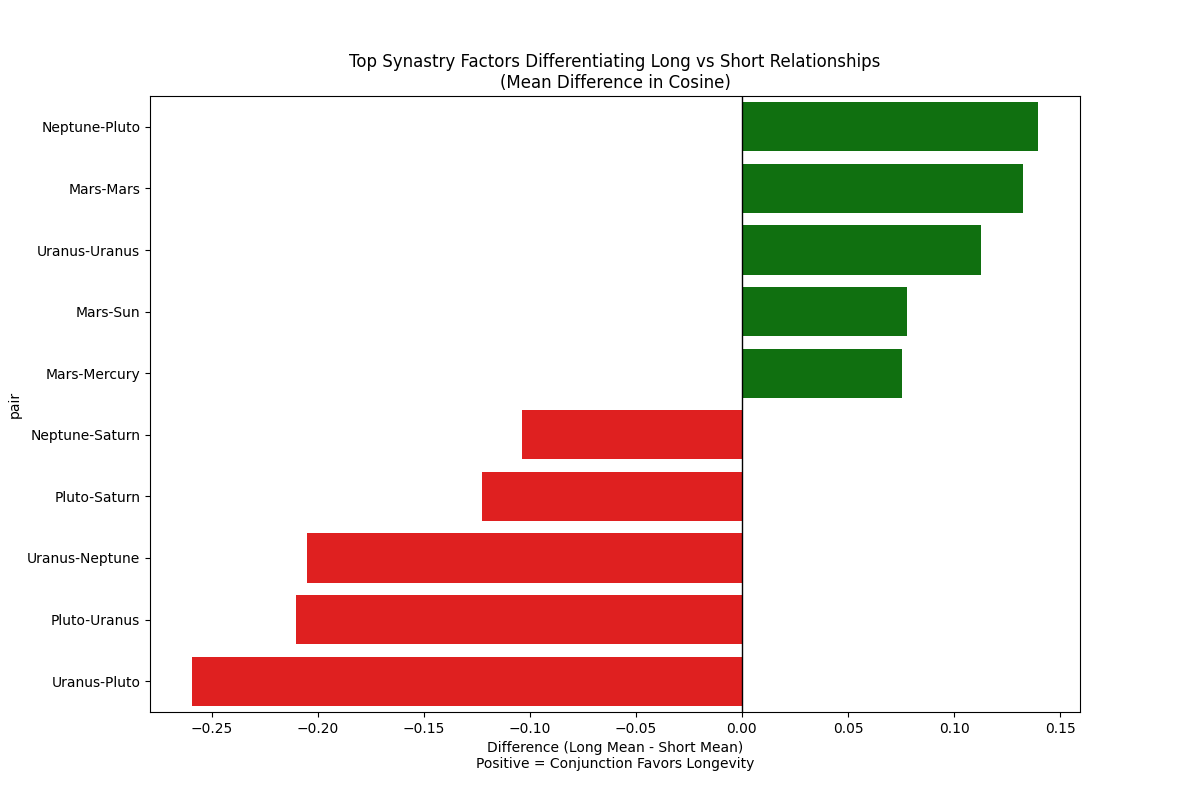
The bar chart below (viz_top_factors.png) ranks the synastry pairs by their "Mean Difference" between Long and Short relationships. Positive values (Green) indicate that Conjunctions favor longevity, while Negative values (Red) would indicate Oppositions favor longevity. The chart clearly separates the massive demographic artifacts (Pluto/Uranus) from the genuine Mars signal.
| P1-P2 Pair | Mean Diff | P-Value | Note |
|---|---|---|---|
| Pluto-Pluto | +0.041 | <0.001 | Age Artifact |
| Neptune-Pluto | +0.139 | <0.001 | Age Artifact |
| Mars-Mars | +0.133 | 0.0006 | Genuine Astrological Signal |
| Pluto-Saturn | -0.123 | 0.0016 | Saturnian Stability/Age mix |
| Neptune-Saturn | -0.104 | 0.0067 | Saturnian Stability/Age mix |
Final Verdict
Perhaps for predicting whether a marriage will last "Until Death Do Us Part":
- Marry someone your own age (Outer Planet Conjunctions).
- Marry someone who fights like you do (Mars-Mars Conjunction).
- Don't rely on Venus (Romantic compatibility does not equal endurance).